Two lists landed in October.
The first celebrates women at the top of the legal profession. The second celebrates senior people who got there, or stayed there, on reduced hours. They measure different things, so we have kept them separate below. But read together, they say the same thing: the shape of a senior legal career is no longer fixed.
NZ Lawyer and Australasian Lawyer have named 105 women in their sixth annual Elite Women report, selected by their editorial teams from industry nominations across both countries.
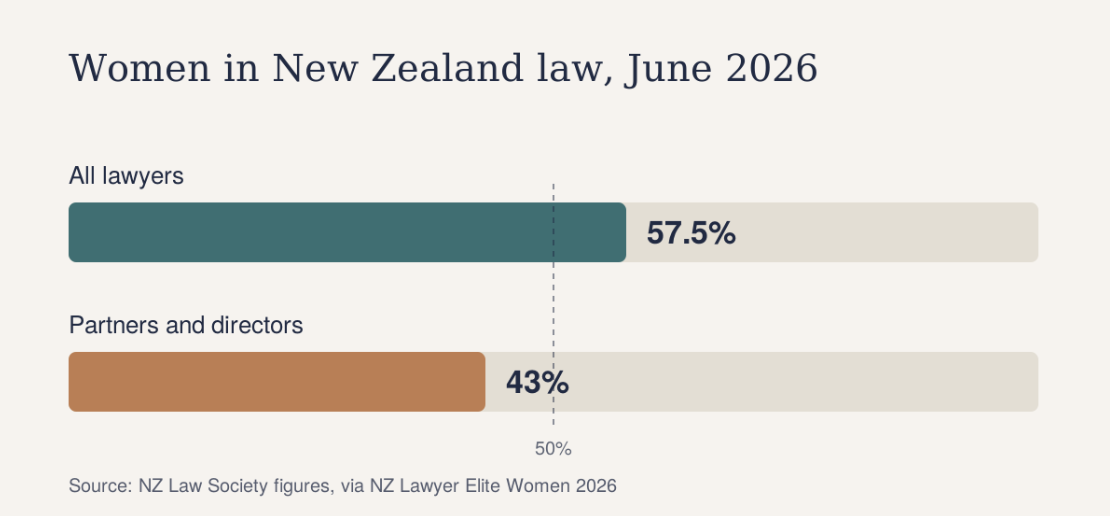
The full report opens with a familiar gap. On New Zealand Law Society figures supplied for it, women made up 57.5% of New Zealand lawyers in June 2026 but held 43% of partner and director roles. In the report's survey of winners, 56% said younger women lack enough female leaders to follow.
What stands out is how this year's winners are responding. The report finds them pushing flexible work, rewarding staff in non-traditional ways, opening firm governance to people below partner level, and actively sponsoring junior women rather than simply mentoring them.
Auckland's Alissa Bell, the first female chair of McVeagh Fleming, is a good example. Every staff cohort at her firm, from support staff to senior associates, now meets quarterly with management to give feedback. On why visible leaders matter, she told the magazine: "The more you see it, the more you know that it's possible."
The South Island is well represented too, including Danita Ferreira of Wynn Williams, and Ashley-Jayne Lodge and Ingrid Taylor of Anderson Lloyd.
Now in its third year, the NZ Part-Time Power List, created by Emma McLean of Works For Everyone, profiles people in senior, career-building roles on reduced hours. Three lawyers made the 2026 list:
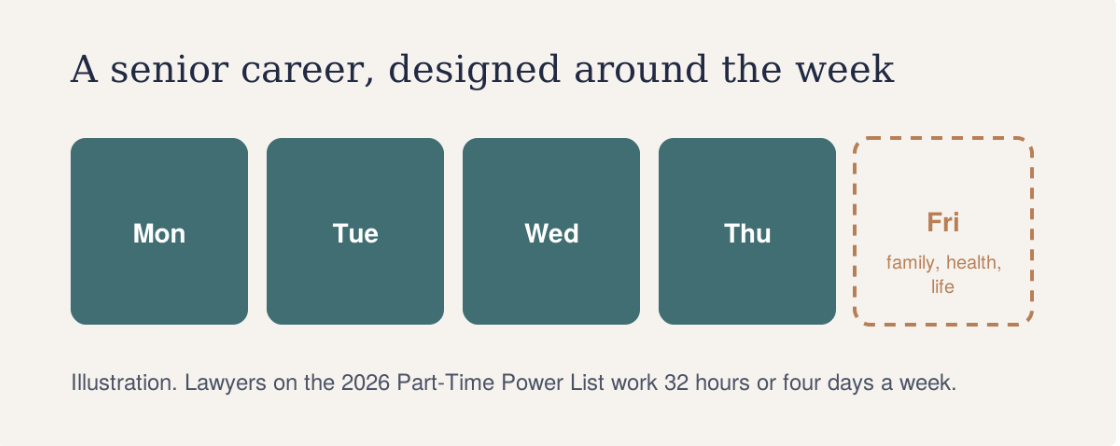
McLean's argument is that employers need to bring more imagination to how we design jobs. Parents who leave senior roles, she says, have often not chosen to go. They have simply run out of options because no meaningful part-time role was on offer.
She is also frank about the gaps. There are no job shares on this year's list, and it remains mostly women with limited ethnic diversity, which she puts down to who currently sits in senior leadership.
From where we sit, recruiting lawyers every week, a few things follow for anyone planning the next ten to fifteen years.
Partnership on reduced hours is real. Two partners on the Power List work 32 hours or four days. If a firm tells you seniority requires five full days, that is a choice the firm is making, not a rule of the profession.
Judge firms on structure, not perks. A wellness budget is nice. Better questions: who sits on committees below partner level, how is good work allocated, and are reduced-hours roles scoped to fit the hours, or is a full-time job squeezed into four days?
Find a sponsor, not just a mentor. A mentor gives advice. A sponsor puts your name forward when promotions are decided. The Elite Women winners treat sponsorship as part of the job.
Negotiate with evidence. The profiles on both lists are practical proof that these arrangements work. Take them into the conversation with you.
Chisholm Clarke is a dedicated legal search firm, synonymous with expert and confidential legal career guidance in New Zealand. More than just finding and securing qualified lawyers new jobs, we provide detailed market information, sound advice and smooth private job searching services tailored to each individual.
We also produce the What a Lawyer podcast, provide interviewing workshops for graduates and new lawyers entering the profession, sponsor an annual charity golf tournament for lawyers and have international partnerships to support lawyers heading overseas. We have a relaxed yet professional approach, with 60+ public reviews to back it up. If you would like to start a confidential conversation about your options or how to structure your job search, reach out to Sam today on 0275665707 or sam@chisholmclarke.co.nz.
And to keep your CPD on track wherever you work, take a look at Lawyer Up, our new CPD app for New Zealand lawyers.